Frappe
Cloud
Marketplace
Frappe
Products
Insights

Installation Guide
installs
Publisher
Supported versions
Categories
E-Commerce
dd4bb3.webp)
adcfb7.webp)
About
UAE E-Invoicing Integration for ERPNext
A Frappe / ERPNext application for generating UAE E-Invoicing-ready invoice data, aligned with the upcoming UAE Federal Tax Authority (FTA) e-invoicing framework and UBL 2.1 standards.
This app is designed to help ERPNext users prepare structured invoice payloads, validate UAE VAT-related requirements, and support future API-based invoice clearance and reporting workflows.
Overview
The UAE E-Invoicing Integration app provides a configurable foundation for UAE-compliant e-invoicing inside ERPNext.
It focuses on:
• Generating UAE-compliant invoice data • Preparing structured JSON payloads for future XML / UBL 2.1 mapping • Validating VAT, TRN, HS Code, SAC Code, and invoice rules • Supporting Sales Invoices, Credit Notes, and self-billed documents • Preparing ERPNext invoices for future FTA clearance and reporting workflows
Note
The integration is designed with a flexible ASP (Accredited Service Provider) architecture. Any UAE-approved ASP provider can be configured and integrated with this app based on customer requirements and future UAE FTA compliance specifications.
Currently, Flick is available as the initial test and reference implementation for API connectivity and workflow validation.
UAE e-invoicing is currently being rolled out in phases. This implementation is designed to be future-ready, configurable, and aligned with published UAE FTA and PEPPOL-style standards.
At the current stage, the structured invoice JSON generation layer is implemented. FTA submission and full clearance workflow will be added in future phases.
Features
• Sales Invoice and Credit Note support • VAT category and tax breakdown handling • HS Code validation for goods • SAC Code validation for services • Invoice Transaction Type Code support • Payment Means Code support • Legal Entity and Registration Identifier handling • Customer and Supplier identification blocks • Structured JSON generation • UBL 2.1-compatible mapping structure • OAuth2 authentication preparation • API configuration fields • Participant details fetch support • Webhook-ready design for real-time invoice status updates • Designed for ERPNext v16+
Supported Document Types
Sales / Accounts Receivable
| Code | Document Type |
| 380 | Commercial Invoice |
| 480 | Out of Scope Invoice |
| 381 | Credit Note - Taxable |
| 81 | Credit Note - Out of Scope |
Purchase / Accounts Payable
| Code | Document Type |
| 389 | Self-Billed Invoice |
| 361 | Self-Billed Credit Note |
Validation Highlights
The app includes validation rules to ensure invoice data is structured correctly before generation.
Key validations include:
• Quantity must be greater than zero • Mandatory tax category must be present • Credit Notes must have a valid reference invoice • Legal identifiers must be configured before submission • VAT / TRN details must be available where required • HS Code is required for goods • SAC Code is required for services • Decimal precision is handled using ROUNDHALFUP • Invoice transaction type must be valid • Payment means code must be valid
Configuration
Enable UAE E-Invoicing
Go to:
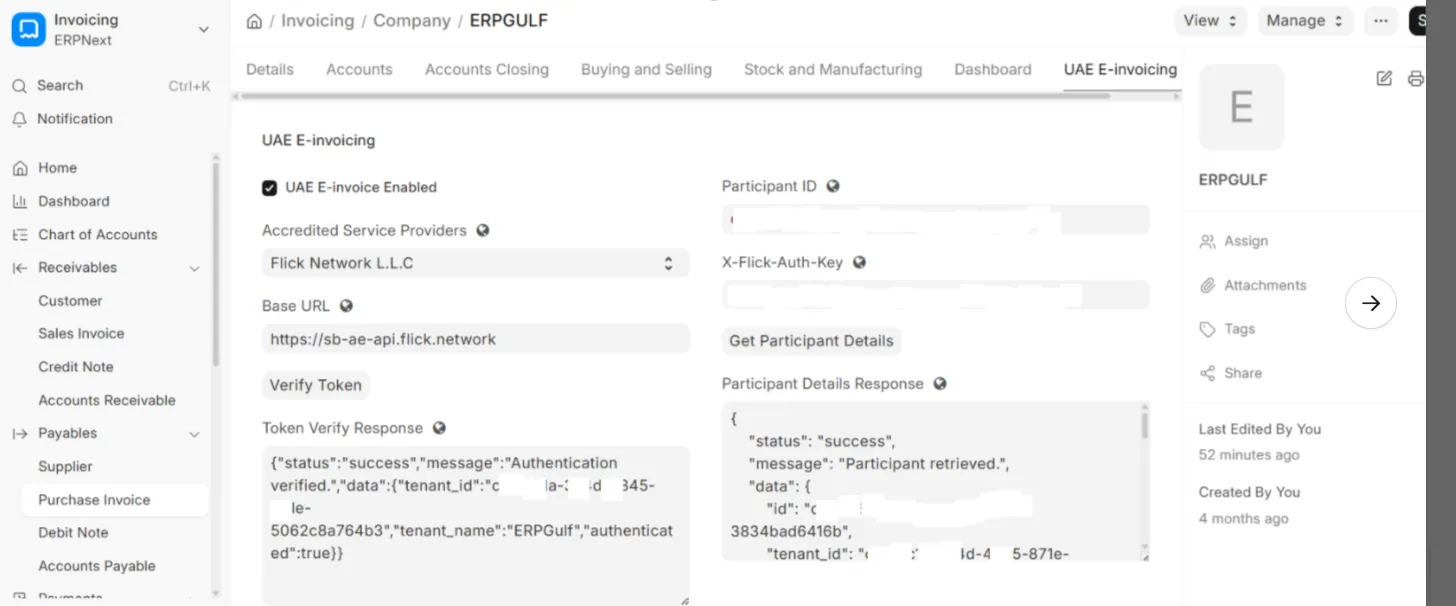
Company → UAE E-Invoicing
Enable:
UAE E-Invoice Enabled
Make sure the company has the correct legal and tax details configured.
API Setup
Configure the API connection details.
Required fields:
• Base URL • Participant ID • X-Flick-Auth-Key
These details are used for connecting with the external e-invoicing API service.
Authentication
The app is designed to support OAuth2-based authentication.
Authentication flow:
Verify token Generate OAuth2 access token Store token securely Reuse token until expiry Regenerate token when expired

Fetch Participant Details
The participant details flow retrieves business registration information such as:
• VAT / TRN • Business legal name • Registration details • Participant information • Address and identification details
This helps ensure the company is properly registered and ready for invoice submission workflows.
Invoice Flow
The expected UAE e-invoicing flow is:
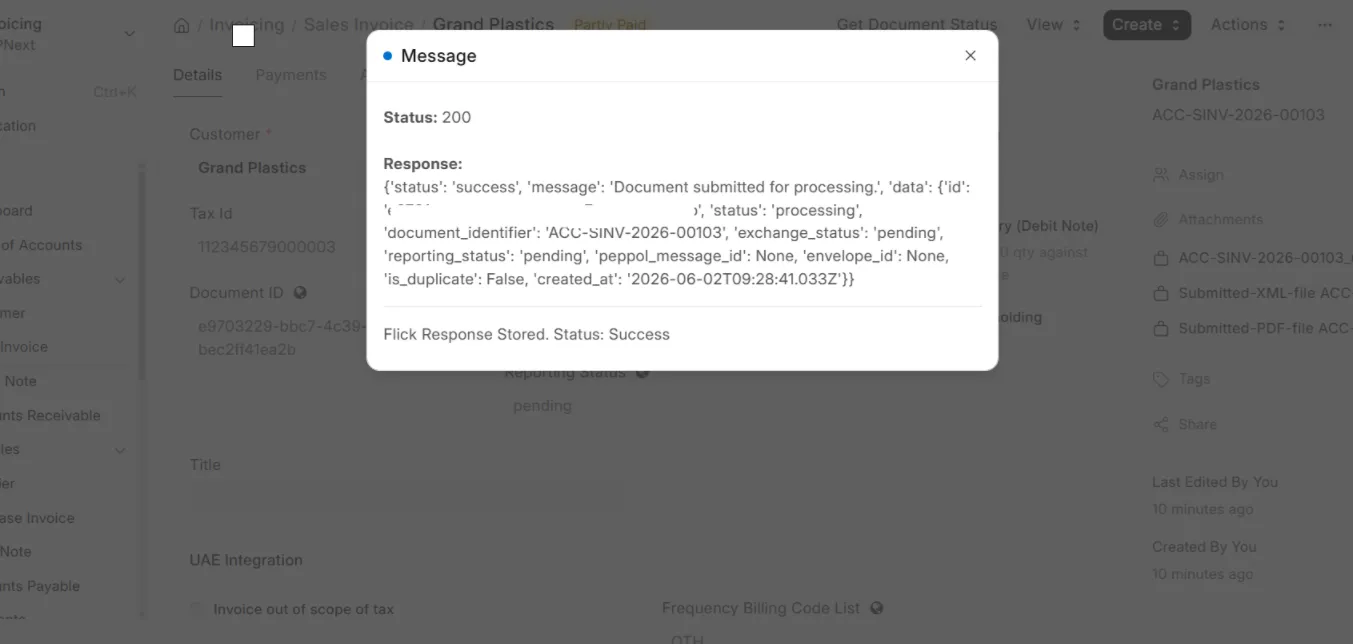
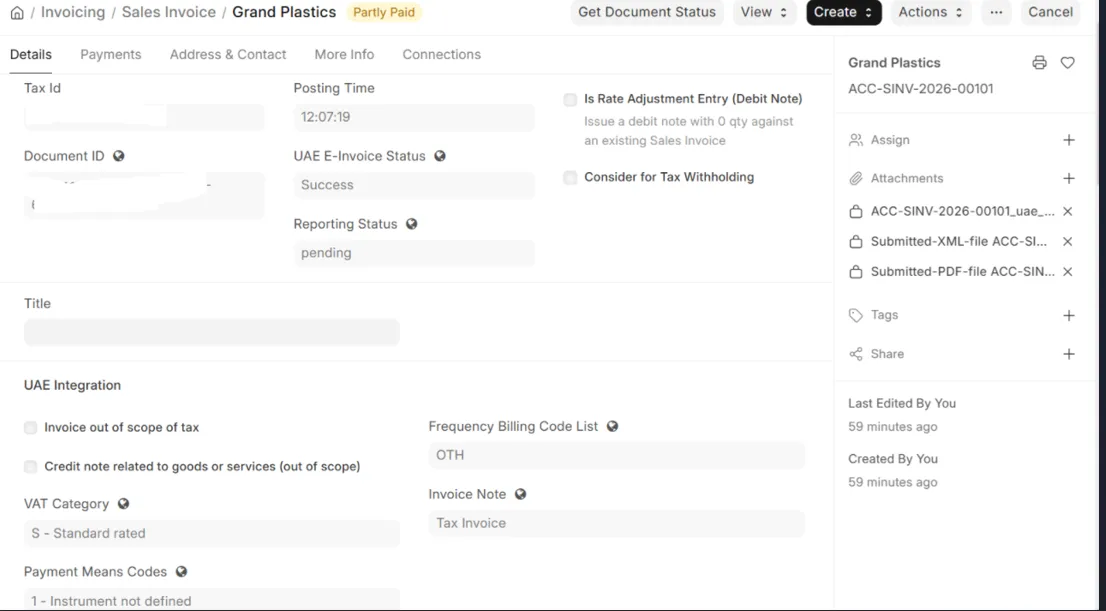
User creates a Sales Invoice in ERPNext System validates UAE E-Invoicing configuration System validates invoice data Invoice payload is generated Authentication is performed using OAuth2 Invoice is sent to the configured API provider API provider forwards invoice data to the FTA Response is received and stored in ERPNext


flowchart TD
A[Create Sales Invoice] --> B[Validate Configuration]B --> C[Validate Invoice Data]C --> D[Generate Invoice Payload]D --> E[OAuth2 Authentication]E --> F[Send to API Provider]F --> G[Forward to FTA]G --> H[Store Response in ERPNext]
`

Webhooks
The app is designed to listen for real-time invoice status updates using webhooks.
Supported webhook events include:
• Invoice Submitted • Invoice Validated • Invoice Accepted • Invoice Rejected • Invoice Delivered
Webhook responses can be used to update invoice status inside ERPNext.


Output Formats
Currently supported output:
• Structured Invoice JSON
Planned output:
• UBL 2.1-compatible XML • FTA-ready invoice submission payload • API clearance response mapping
Current Status
Only the structured JSON generation layer is currently implemented. FTA submission and full clearance workflows are not yet completed and will be added in future phases.
Tech Stack
• ERPNext • Frappe Framework • Python • REST APIs • OAuth2 Authentication • Webhooks • JSON payload generation • UBL 2.1-compatible data structure
App Structure
Typical app structure:
text uaeerpgulf/ ├── uaeerpgulf/ │ ├── hooks.py │ ├── modules.txt │ ├── patches.txt │ └── uaeerpgulf/ │ ├── doctype/ │ ├── api/ │ ├── utils/ │ └── validations/ ├── README.md ├── pyproject.toml └── license.txt
Key Modules
The app may include modules for:
• UAE E-Invoicing Settings • Invoice JSON generation • VAT validation • HS / SAC code validation • Customer and supplier mapping • Legal identifier handling • API authentication • Participant detail fetch • Webhook handling • API response storage
Important Notes
Before using the app, ensure that:
• Company VAT / TRN details are correct • Customer VAT / TRN details are maintained where applicable • Item HS Codes are configured for goods • SAC Codes are configured for services • Tax templates are correctly mapped • API credentials are kept secure • Invoice data follows the required structured format • Credit Notes are linked to their original invoices
Benefits
Using this app can help businesses:
• Improve UAE VAT compliance readiness • Reduce manual invoice preparation work • Standardize invoice data • Improve accuracy and transparency • Prepare for future UAE FTA e-invoicing requirements • Maintain structured invoice records inside ERPNext • Support faster invoice processing workflows
Planned enhancements include:
• Full UBL 2.1 XML generation • FTA clearance submission • API response handling • Invoice status tracking • Advanced webhook processing • Debit Note support • Purchase invoice self-billing enhancements • PEPPOL-compatible document exchange • Additional validation rules based on final UAE FTA specifications
References
• UAE Federal Tax Authority • UBL 2.1 Specification • PEPPOL BIS Billing 3.0
Compatibility
| Component | Version |
| Frappe Framework | v16+ |
| ERPNext | v16+ |
| Python | As supported by Frappe v16 |
| Database | MariaDB / PostgreSQL as supported by Frappe |
License
This project is licensed under the terms specified in the license.txt file.
Maintainer
Developed and maintained by ERPGulf.
For implementation, customization, or support, please contact the project maintainer.
Contact us for Support
Email: [email protected]
Author: HUSNA M — https://medium.com/nothing-big
User Reviews
No reviews yet, be the first to review.
0.0
0 rating
More apps from

Explore more apps