Frappe
Cloud
Marketplace
Frappe
Products
Insights

Installation Guide
installs
Publisher
Supported versions
Categories
E-Commerce
About
ERPNext 🇿🇦 South Africa Compliance & VAT by Cohenix
Overview
This app does two jobs. It makes ERPNext behave like a South African VAT vendor, and it is the governance foundation the rest of the Cohenix SA suite depends on.
As the VAT vendor it classifies supplies, applies the VAT Act's tax-invoice particulars to commercial documents, and builds a VAT201 working paper that reconciles back to the ledger entries that produced it.
As the foundation it answers the questions every South African compliance feature depends on: which statutory rule applies to this company on this date, who approved it, whether a capability is ready for production use, which obligation is due, and where the evidence is.
Why it exists
South African statutory values change every year, and several change mid-year. An engine that hard-codes a rate is wrong the moment the gazette moves — and worse, it is wrong silently. This app makes the provenance of every statutory value explicit and date-effective. A rate is usable only when it is attached to a recorded source, carries effective dates, and has been approved by someone other than its author.
Governance features
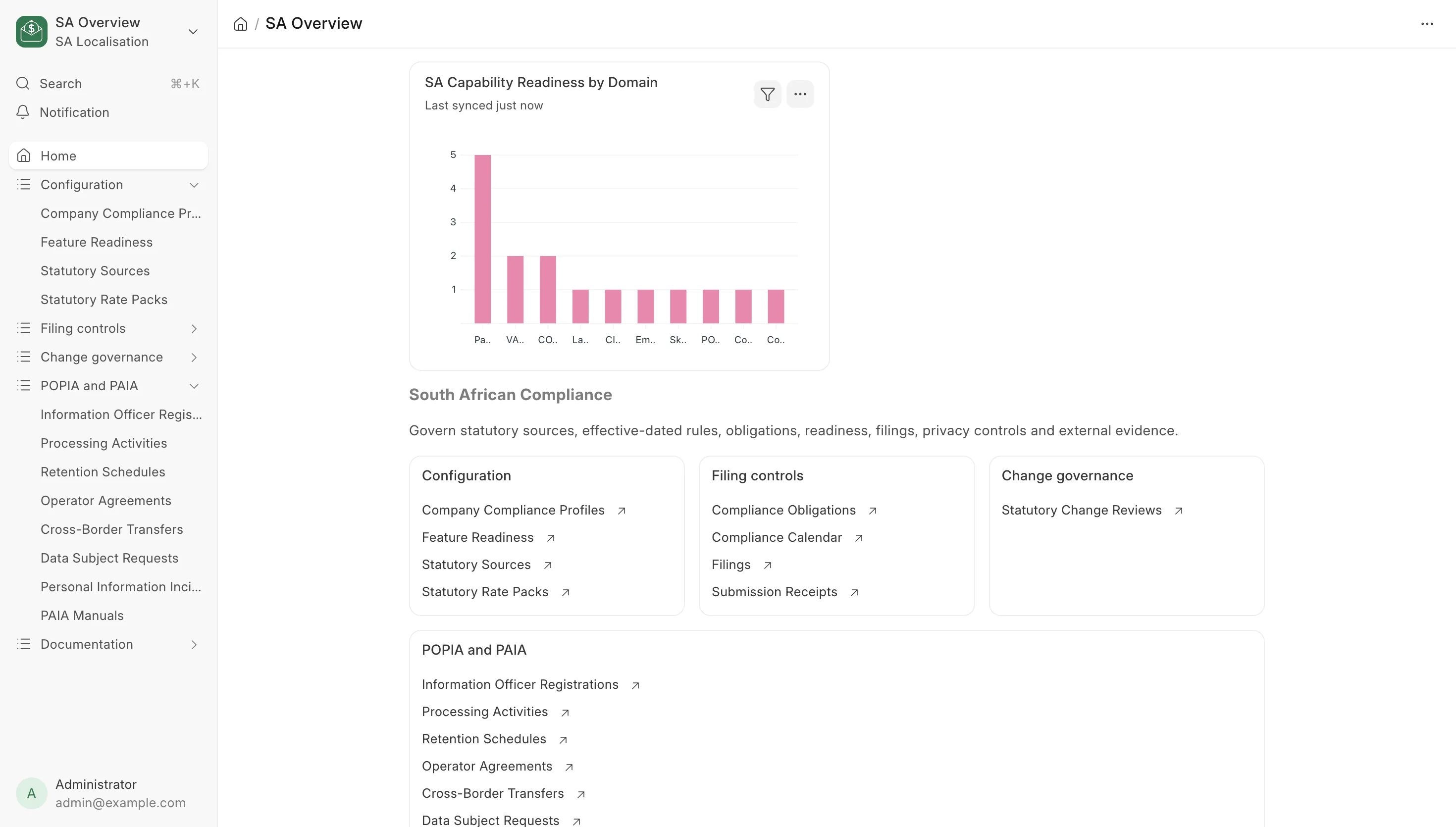
Company Compliance Profile — records which obligations actually apply, so a business that is not a VAT vendor is never asked for returns it does not owe.
Statutory Sources — immutable records of the gazette, guide or BRS a rule came from, with publication date, URL and evidence checksum.
Statutory Rate Packs — effective-dated, reviewer-approved values with overlap rejection.
Compliance Obligations and Calendar — what is due, for which period, by when.
Filings and Submission Receipts — separation of preparer and approver, plus the authority's actual acknowledgement.
Feature Readiness — every capability declares whether it is Production, Controlled Manual, Preview, Unsupported or Blocked, with the reason and remediation route.
POPIA and PAIA registers — Information Officer registrations, processing activities, retention schedules, operator agreements, cross-border transfers, data-subject requests, personal-information incidents and PAIA manuals.
VAT features
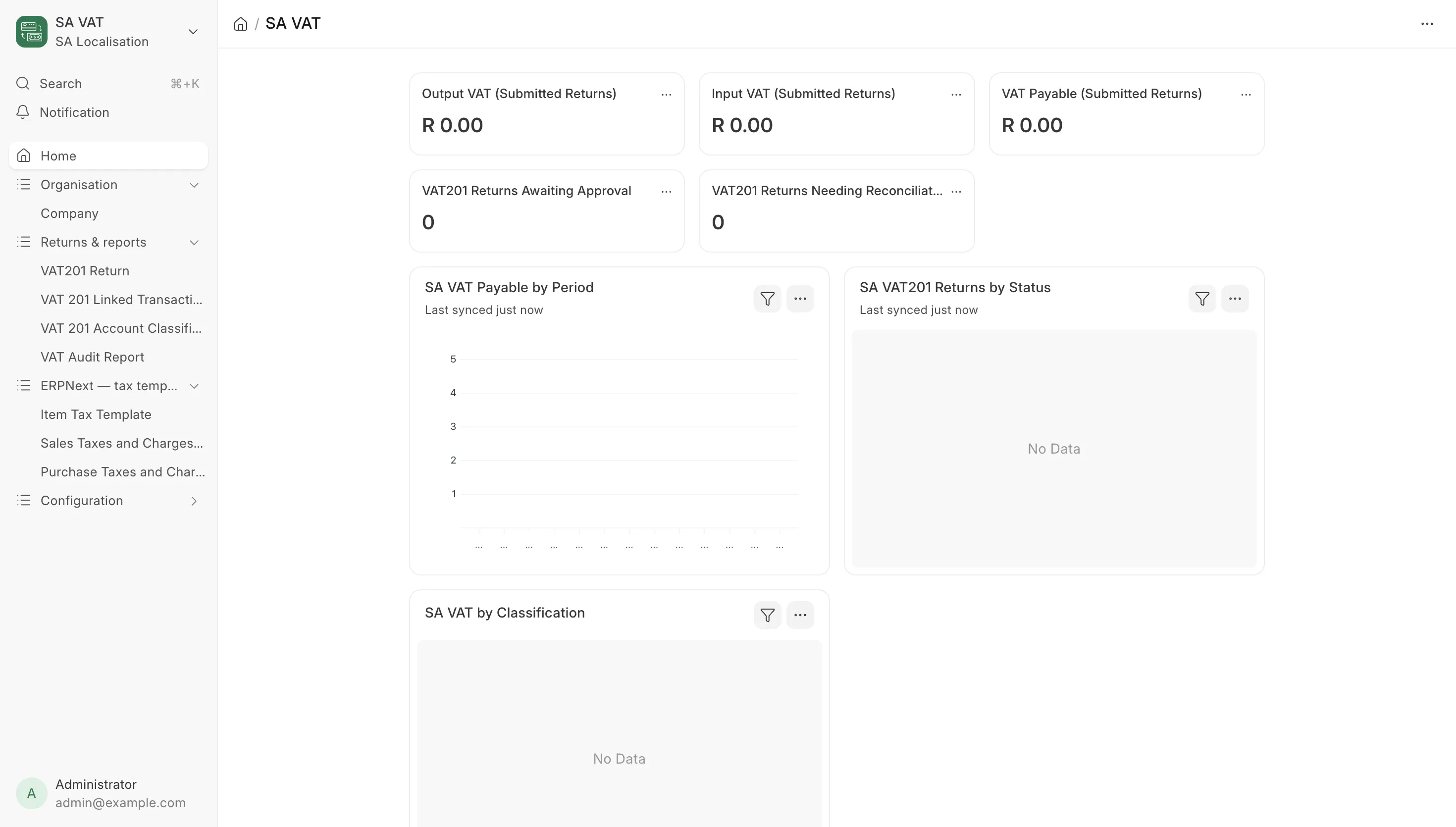
South Africa VAT Settings — company-scoped registration, category and account mapping, validated against enabled tax ledgers.
Supply classification — standard-rated, zero-rated and exempt supplies; capital and non-capital inputs; local versus imported input tax.
Tax-invoice controls — full, abridged and no-invoice-required thresholds resolved from an approved rate pack, with a readiness check listing exactly which VAT Act particulars are missing.
Commercial print formats — SA sales invoice, full and abridged tax invoice, credit and debit note, purchase invoice, quotation, sales and purchase order, delivery note and payment entry.
VAT201 Return — period-scoped working paper with source-to-ledger reconciliation, an immutable snapshot on submission, and maker-checker review before filing.
Reports — VAT 201 Linked Transactions, VAT 201 Account Classifications and a VAT Audit Report, all permission-filtered.
Chart of Accounts augmentation — South African VAT ledgers added without overwriting existing accounting configuration.
Workspaces
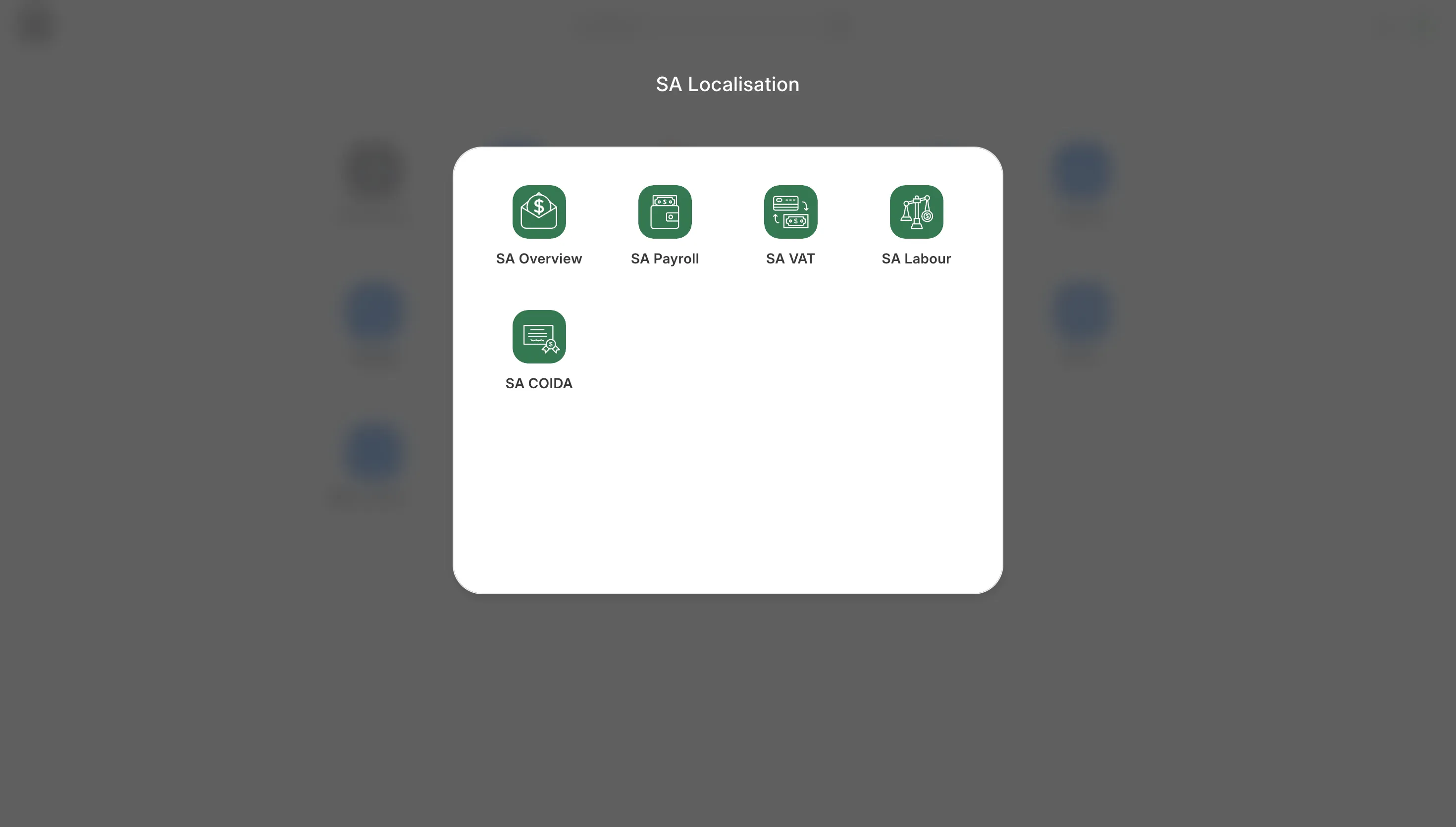
SA Overview — central landing page, setup guidance, onboarding and cross-module navigation.
SA VAT — VAT settings, VAT201 working papers, VAT reports, transaction review and tax-invoice readiness.
Country scope
Every statutory rule is gated on the company's country. A site may hold companies in several countries; those outside South Africa keep stock Frappe and ERPNext behaviour and are never blocked by South African setup they cannot complete.
Filing boundary
This app prepares and evidences returns. It does not transmit them to SARS. Submission remains a deliberate human act on eFiling.
Requirements
Frappe and ERPNext. HRMS is not required.
Important Compliance and Responsibility Notice
This application is intended to assist with South African localization, statutory configuration, calculation support, reporting, and working-paper preparation inside ERPNext.
Cohenix and EPI-USE do not accept responsibility or liability for incorrect calculations, incorrect configuration, inaccurate statutory submissions, missed deadlines, penalties, losses, or any other consequences arising from the use of this application.
All calculations, reports, statutory values, payroll results, VAT returns, COIDA returns, Employment Equity outputs, and related submissions must be reviewed and validated by a suitably qualified payroll practitioner, accountant, tax practitioner, or responsible employer representative before being used for statutory filing, payment, reporting, or decision-making.
The application does not replace professional judgment, tax advice, payroll review, accounting review, or legal compliance review. Final responsibility for configuration accuracy, calculation validation, legislative interpretation, statutory submissions, and compliance remains with the employer and the appointed practitioner.
Community and Contribution
South African statutory compliance is complex and changes over time.
Cohenix welcomes feedback, testing, issue reports, and contributions from the ERPNext community, payroll practitioners, accountants, and implementation partners to improve the accuracy, coverage, and long-term sustainability of South African localisation for ERPNext.
User Reviews
No reviews yet, be the first to review.
0.0
0 rating
More apps from



Explore more apps